This is part 4 of the following series:

  1. Originating requirements
  2. Use cases
  3. Product requirements specification
  4. Physical architecture and interfaces (this document)

The document maps all specifications to hardware or software interfaces. To contribute more contents, identify all external interfaces and describe all properties that meets the system-level specifications: mechanical / optical / electrical / softrware. Omit all internal interfaces; those should reside in code comments or in the technical reports.

How to use this document

This document follows the Product Requirement Specifications (PRS), where the interfaces linking various sub-systems are captured.

There are also lower level internal interfaces; these are often the interfaces that are owned by a single engineer (e.g. the electrical interfaces found on a single circuit board). These lower level interfaces are not given a number and description, are not turned into requirements, and instead are captured in lower level specifications and design documentation.
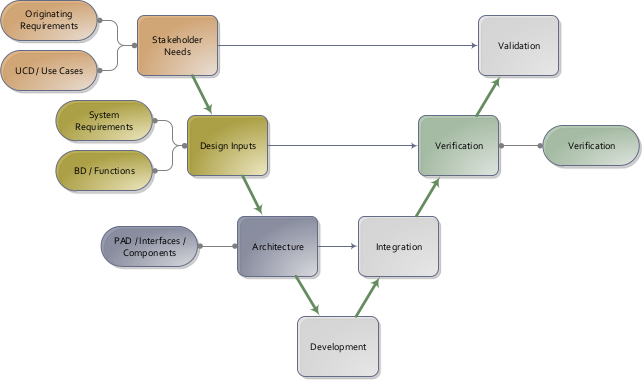
System engineering V-model. Component-level designs are captured following the system-level specifications.

Similar to defining use cases, the process of capturing the architecture via a Physical Architectual Diagram is helpful to ensure that the interfaces are identified. For particularly complicated interfaces, the descriptions above can reference a more detailed document (such as a mechanical interface drawing, electrical pinout, firmware/software communication protocol, etc.).

The Logical Architecture Diagram (LAD) groups the functions into sub-systems. Flows among functions are mapped to Interfaces, featuring interactions among sub-systems. The LAD is in turn implemented by physical components in the Physical Architecture Diagram (PAD). The PAD links all external interfaces with the corresponding internal components of the system.
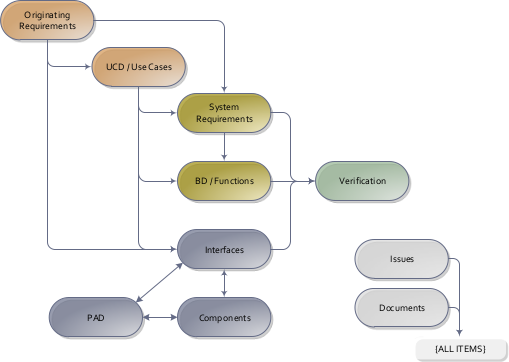
Interface specifications are traced back to the Originating Requirements, and are verified by the Verification Plans. The Physical Architecture Diagram (PAD) links all external interfaces with the corresponding internal components of the system.

Logical architecture

pad-1: Autonomy stack

A logical autonomy stack linking localization, planning, control, and vehicle actuation.
Autonomy stackSensors[int-4] Sensor observation interfaceLocalization subsystem[int-1] Pose estimate interfacePlanner[int-2] Trajectory interfaceController[int-3] Control command interfaceVehicle actuatorsVehicle operatorsupervise
Component diagram "pad-1: Autonomy stack"

int-1: Pose estimate interface

The localization subsystem publishes the most recent vehicle pose estimate to the planner.

Satisfies:

  • [sys-1] Valid pose computation:The localization system shall compute a valid pose.
  • [sys-2] Pose publication rate:The localization system shall make the most recent pose estimate available at x Hz.

Software / firmware descriptions

  • The interface shall provide the most recent pose estimate at the allocated publication rate.

int-2: Trajectory interface

The planner provides a selected trajectory to the controller.

Satisfies:

  • [fnc-1.3] Compute control command:The control function shall compute a control command from the selected trajectory.

Software / firmware descriptions

  • The interface shall communicate the current trajectory selected for autonomous motion.

int-3: Control command interface

The controller provides control commands to the vehicle actuators.

Satisfies:

  • [sys-3] Control computation:The control system shall compute an accurate control command.

Software / firmware descriptions

  • The interface shall communicate steering, throttle, and braking commands to the actuation layer.

int-4: Sensor observation interface

Vehicle sensors provide observations to the localization subsystem.

Satisfies:

  • [fnc-1.1] Compute valid pose:The localization function shall compute a valid pose estimate for downstream autonomy functions.

Software / firmware descriptions

  • The interface shall provide the sensor observations required for localization.

Physical architecture